

Tennis: everything you need to know before stepping onto the court
Everyone thinks they know tennis. Then you find yourself on a court, your opponent announces "30-love," and you nod without really knowing why. This guide covers everything from the start: the scoring, the vocabulary, the surfaces, the four Grand Slam tournaments, what to wear, and the unwritten rules. Everything you need to play, watch a match, or hold your own at the clubhouse.

Table of Contents
- How to keep score in tennis
- Tennis vocabulary, from "ace" to "let"
- Clay, grass, hard: the surfaces
- The four Grand Slam tournaments
- What to wear to play tennis
- The unwritten rules of the court
- Getting started with tennis
- Frequently asked questions
How to keep score in tennis
Tennis scoring is built on three tiers: points make a game, games make a set, and sets make a match.
The points: 15, 30, 40, game
Zero is "love" in English. Then it goes 15, 30, 40, and then game. You must win four points to win a game, with at least a two-point lead. The server always announces their score first: "30-15" means the server is leading.
Why 40 and not 45?
No one knows for sure. The most common theory refers to an old way of counting by quarter-hours on a clock: 15, 30, 45. The 45 allegedly became 40 because it was shorter to say. Another theory traces it back to "jeu de paume," the French ancestor of tennis. What we do know is that the system has outlasted everything else.
What about "love"?
The most cited explanation: "l'œuf" (the egg), for the shape of the zero, which the English deformed into "love." Nothing is proven, but it’s our favorite version.
Deuce, advantage, game
At 40-40, it is called "deuce." The player who wins the next point takes the advantage. If they win the following point, they win the game. If they lose it, it goes back to deuce. A game can last a very long time.
The set and the tie-break
A set is won by reaching six games, with a two-game lead: 6-4, 7-5. At 6-6, a tie-break is played: the first to seven points with a two-point lead wins the set 7-6. In Grand Slam tournaments, the deciding set has been settled since 2022 by a 10-point super tie-break at 6-6.
The match
Generally, it's the best of three sets. Men play the best of five sets in Grand Slam tournaments, which explains why those matches last four or five hours.

Tennis vocabulary, from "ace" to "let"
- Ace: A winning serve that the opponent doesn't even touch.
- Double fault: Two missed serves in a row; the point goes to the opponent.
- Let: On a serve, the ball hits the net and falls into the correct service box. It is not a fault; the serve is replayed.
- Break: Winning a game on the opponent's serve. A "re-break" is winning it back immediately after.
- Break point, set point, match point: The point that can turn the game, the set, or the match.
- Foot fault: The server touches the baseline before hitting the ball. The serve is a fault.
- Forehand, backhand, volley, lob, drop shot, smash: The basic shots. A drop shot dies just behind the net, while a lob goes over an opponent who has moved to the net.
- Chop: A ball hit with heavy backspin, causing it to bounce low.
- Bagel: A set won 6-0. It's best not to say it too loudly in front of your opponent.
For training: The Men's Tennis T-Shirt, white with green embroidery, in organic cotton. The t-shirt you pull on for the first set and keep on for the terrace afterwards.
Clay, grass, hard: the surfaces
The surface changes everything: ball speed, bounce height, and how you move.
Clay
Crushed brick on a draining base. The ball slows down and bounces high, leading to longer rallies. You slide into your shots and go home with orange socks. It is the surface of Roland-Garros and most clubs in the south of France.
Grass
The fastest surface, and the rarest too. The ball skids and stays low: service and volleying are king. Grass is only played for a few weeks a year, in June and July, with Wimbledon as the highlight.
Hard court
Concrete or resin, blue or green. Consistent bounce, medium speed. It is the most common and easiest surface for beginners; it’s the surface used for the Australian Open and the US Open.

The four Grand Slam tournaments
| Tournament | City | Surface | Period |
|---|---|---|---|
| Australian Open | Melbourne | Hard | January |
| Roland-Garros | Paris | Clay | Late May – early June |
| Wimbledon | London | Grass | Late June – July |
| US Open | New York | Hard | Late August – September |
Winning all four in the same year is achieving the Grand Slam. Very few players have managed it. Roland-Garros remains the only one played on clay, and the only one in France: if you only see one, this is the one.
What to wear to play tennis
Tennis was long the most codified sport in terms of clothing. At Wimbledon, the outfit must still be almost entirely white. In clubs, the rules have relaxed, but the spirit remains: simple, clean, comfortable pieces.
- A cotton t-shirt or polo: lightweight, allowing freedom of movement in the shoulders for serving.
- Shorts or a skirt with a pocket for the second ball.
- Shoes adapted to the surface: herringbone sole for clay, smoother sole for hard courts. Running shoes can damage your ankles and the courts.
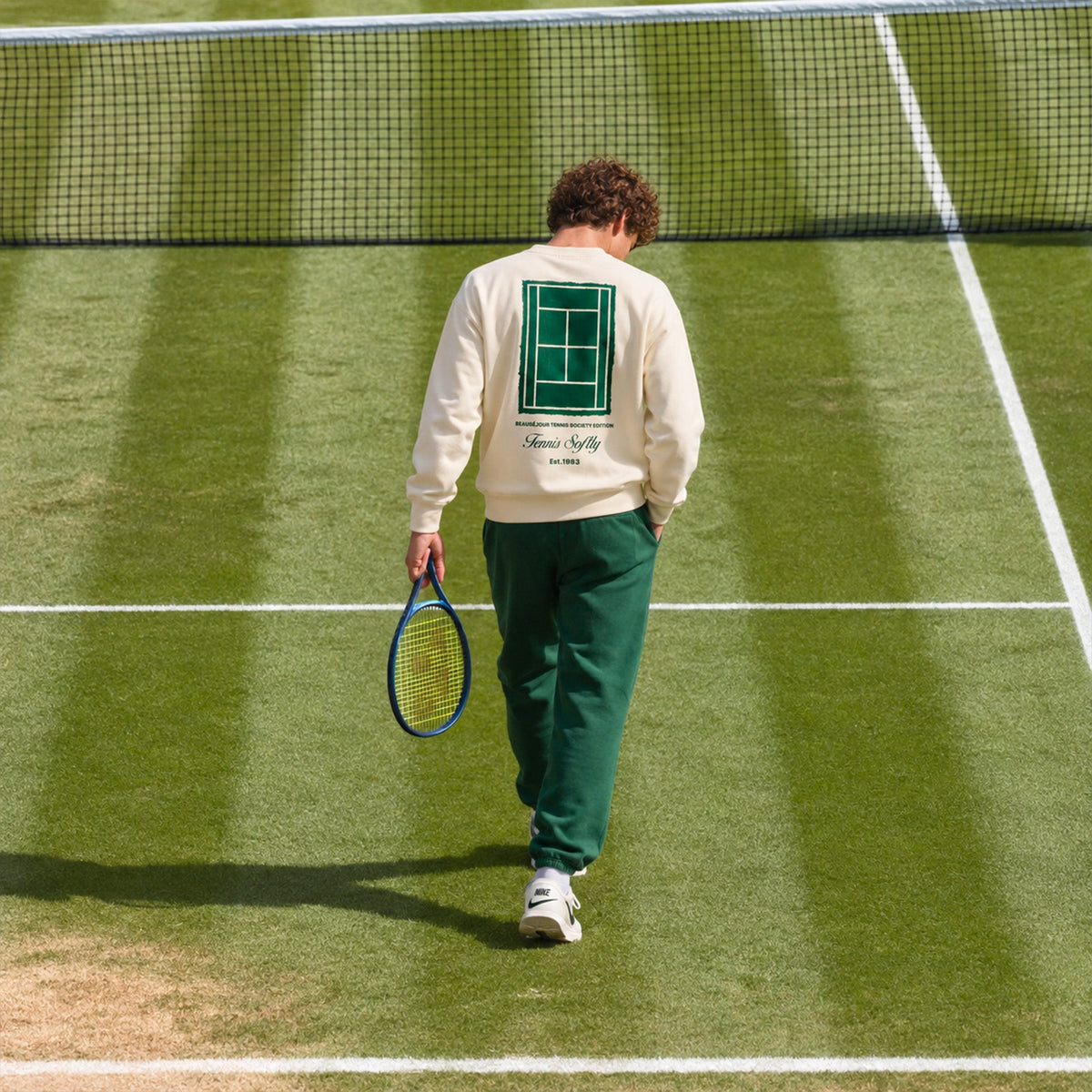
- A sweatshirt for warming up, and especially for after. No one wants to get cold courtside.
- A cap or visor in summer, and tall socks, preferably white.


For the club: The The Beauséjour Tennis Club T-Shirt, blue lettering on the back, like an old 80s club shirt. Also available for men.
The unwritten rules of the court
- Announce the score before serving. Out loud, server's score first. It avoids 90% of arguments.
- The balls on your side are your lines. In friendly matches, each person judges the balls that land in their camp. When in doubt, the ball is good.
- Do not cross behind a court during a point. Wait until the end of the rally, even if it’s long.
- Return stray balls from the neighboring court between points, using your hand or a light tap with your racket—never during a point.
- Raise your hand to apologize for a lucky let. A ball that hits the tape and rolls over for a point is a win, but it’s always worth an apology.
- Shake hands at the net, whether you won 6-0 or lost in a super tie-break.

Getting started with tennis
The simplest way: sign up at a club affiliated with the French Tennis Federation. A membership, a few group lessons, and playing partners at your level. Many clubs offer trial sessions at the start of the season.
- A light racket at the beginning, around 260 to 280g, with a large enough head size to be forgiving of off-center hits.
- New balls: a ball that has lost its pressure bounces poorly and tires the arm.
- A few lessons before playing matches: the serve takes work, and bad habits set in quickly.

For after the match: The cream Tennis Sweatshirt with a clay court printed on the back. It goes from the court to the city without a transition. Also available in grass green, for women and men.
Frequently asked questions
How long does a tennis match last?
A friendly match in two winning sets lasts between an hour and an hour and a half. In Grand Slams, a men's five-set match can exceed four hours.
Who serves first?
A coin toss or spinning the racket decides. The winner chooses to serve, receive, or pick their side of the court. The serve alternates between players every game.
What happens if the ball touches the line?
It's good. The line is part of the court.
How many serves do you get?
Two. If the first is a fault, you get a second ball. Two faults in a row result in a double fault, and the point goes to the opponent. A let does not count as a fault.
Can you play tennis in a cotton t-shirt?
Yes, for recreational play, no problem. A good-weight cotton remains comfortable and does not become transparent. For competition in the middle of summer, many prefer technical fabric for moisture wicking.
Now, you can talk the talk at the clubhouse
Love, deuce, let, break: you have the vocabulary. The rest is played on the court, and the most important part is the coffee afterwards. The Beauséjour Tennis Club collection is made for that moment: tennis t-shirts and sweatshirts, for men and women, inspired by the clubs of the French Riviera.
Read also: tennis sweatshirts and t-shirts, the Beauséjour Tennis Club collection.


Leave a comment
This site is protected by hCaptcha and the hCaptcha Privacy Policy and Terms of Service apply.