

What to do in Casablanca: mosque, Art Deco, Habous and corniche
Casablanca doesn't have the postcard image of Marrakech, and that's a good thing. It's a city that works, honks its horns, was built in white concrete during the 1920s and 1930s, and has kept Art Deco facades on every street corner. You come here for the Hassan II Mosque, you stay for the ocean, the pastries in the Habous district, and fish dinners at the port. What to do in Casablanca for a weekend? We've sorted through it, address by address, without sugarcoating it. And to keep a piece of Casa with you, there's the Beauséjour Casablanca collection.
Hours and opening times vary by season: check before you go.
What to do in Casablanca: the must-sees
Hassan II Mosque — the only one you can visit
It sits partly over the ocean, with a minaret that stands over 200 meters tall. It is one of the few mosques in Morocco open to non-Muslims, by guided tour only: several departures throughout the day, a little fewer on Fridays. Mandatory dress code: shoulders and knees must be covered, no shorts. The time slots, especially in the morning, are posted on the mosque's official website.
The Art Deco center — Boulevard Mohammed V
The real museum of Casa is the street itself. Walk up Boulevard Mohammed V with your head up: wrought-iron balconies, friezes, white buildings that have weathered slightly, which is exactly what gives them their charm. Take a detour through Place Mohammed V and its administrative buildings, then past the facade of the Rialto cinema. Go in the morning, when the light is low and the traffic is still bearable. To go further, the Casamémoire association, which defends this heritage, organizes guided walking tours.
Sacré-Cœur Cathedral — the church turned performance hall
A large white church from the 1930s facing the Arab League Park. It reopened after years of renovation and now serves as a cultural venue: exhibitions, concerts, events. You can't necessarily enter whenever you want, so check the schedule beforehand. From the outside, it's already worth a look.
Arab League Park — a break in the shade
The large park in the center has been completely redesigned. Palm trees, wide paths, families on weekends. It's the place to catch your breath between two neighborhoods, right next to the Sacré-Cœur.
Neighborhoods to explore
Habous Quarter — the new medina
Built in the 1930s to house a population overflowing from the old medina, the Habous district is quieter and cleaner than what one expects of a medina. Arcades, an olive souk, religious bookstores, and leather and copper artisans. Spend a morning there at your own pace. Bring some cash for small purchases.
Pâtisserie Bennis Habous — gazelle horns
The address every resident of Casablanca cites. Gazelle horns, fekkas, and almond cakes sold by weight. Buy a box for the road and another to take home. They sell out fast on weekends.
The Old Medina — the Casa of the past
Tucked between the port and the center, it's rougher around the edges than the Habous. Narrow alleys, laundry hanging from windows, street vendors selling everything. It's not the medina of Fez, and it doesn't try to be. You pass through it to reach La Sqala or Rick's Café, located on its side.
Aïn Diab Corniche — the Atlantic in the city
Several kilometers of waterfront to the west of the city: beach clubs, surfers, joggers at the end of the day. Go at sunset, when all of Casa comes out to walk. At the end, the islet of Sidi Abderrahmane and its white mausoleum, accessible at low tide. The site was rehabilitated in 2024 and is open to visitors again.

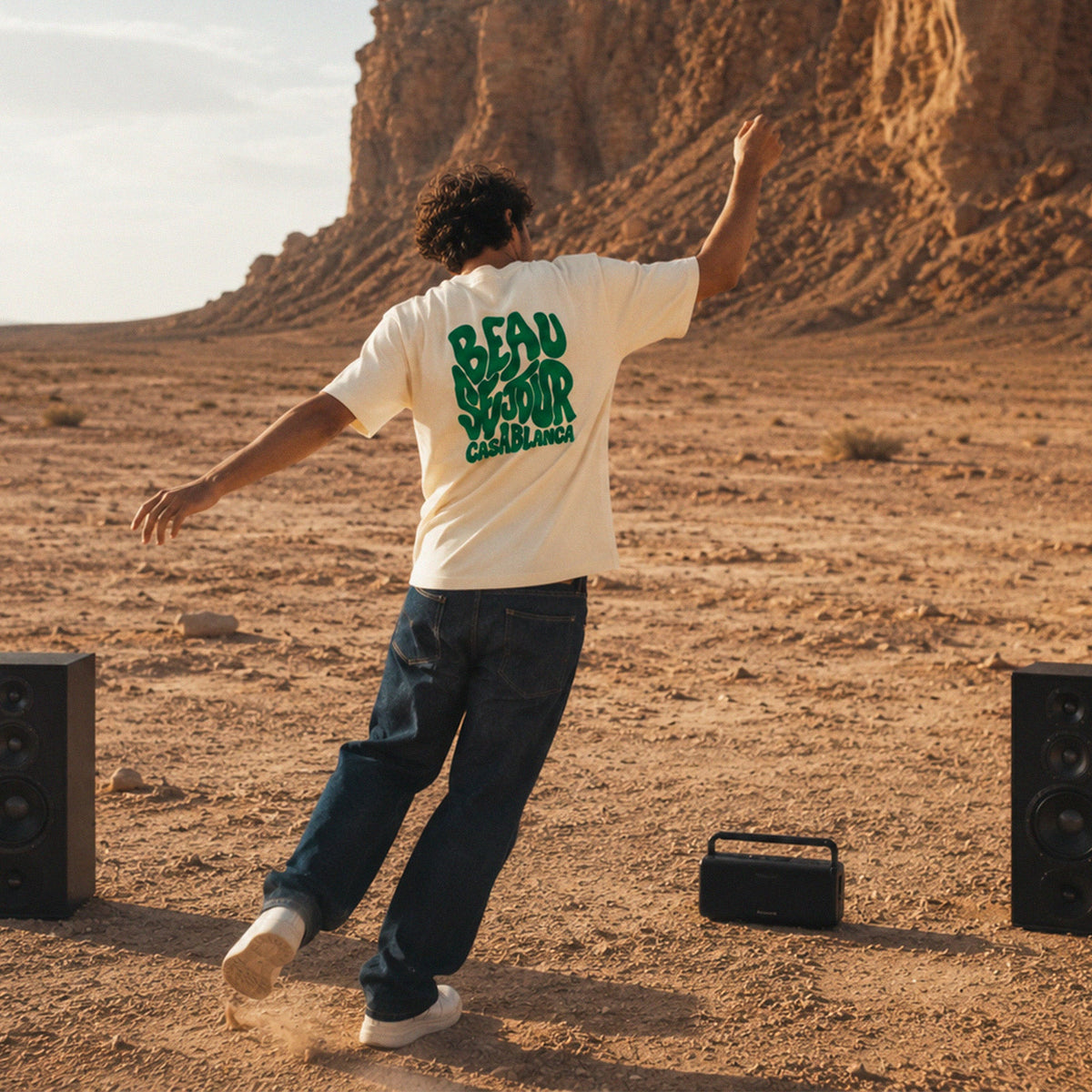
For the corniche at 6 p.m.: the boxy Casablanca T-shirt, with a loose fit and organic cotton, designed for walking facing the ocean when the wind picks up.
Where to eat in Casablanca
La Sqala — lunch in the bastion
A restaurant housed in an old fortified bastion, on the edge of the medina, with an Andalusian garden full of bougainvillea. Classic Moroccan cuisine: tagines, pastilla, cooked salads. The Moroccan breakfast in the morning is worth the trip alone. Book for weekend lunch.
Restaurant du Port de Pêche — the catch of the day
Located within the port area, this is an unassuming room with servers who have seen it all. Fried fish, grilled fish, shrimp, depending on the daily catch. No frills. You go for the food, not the decor.
Le Cabestan — dinner facing the ocean
On the corniche, at the foot of the El Hank lighthouse. The establishment has been around for nearly a century and was completely redesigned. Terrace over the waves, seafood cuisine. Book a table by the bay windows for the sunset.
Rick's Café — the legend, for real
Boulevard Sour Jdid, against the walls of the medina. The film Casablanca was never filmed here, but an American woman recreated the set in 2004 and it works: white patio, brass lamps, piano in the evening. It's touristy, we know. We go anyway, for a drink at the bar if dinner doesn't appeal to you. Reservations recommended.
Have a drink, see exhibits, get out of the city
Skies — Casa seen from above
The panoramic lounge at the top of the Kenzi Tower, one of the two towers of the Twin Center, on Boulevard Zerktouni. A view over the whole city to the mosque. Go up for an aperitif at the hour when the lights turn on.
La Bodega — tapas and music
A downtown tapas bar, a Spanish institution in Casa, with an atmosphere that builds throughout the evening and live music on certain nights. This is where Casa goes out on weekdays. Smart casual dress code, nothing more.
Abderrahman Slaoui Museum — the rainy day plan
A small Art Deco villa on Rue du Parc housing the collection of a major Casablanca collector: orientalist posters, antique jewelry, perfume bottles. An hour is enough, and you'll leave with a different image of Morocco. The temporary exhibition program is on the Casablanca tourism office website.
Villa des Arts — contemporary Moroccan art
Boulevard Brahim Roudani, a 1930s villa transformed into an art center by the Al Mada Foundation. Rotating exhibitions all year round, quiet garden. Combine with the Slaoui Museum in the same afternoon.
El Jadida — the day trip
To the south, accessible by train from Casablanca. The Portuguese city, a UNESCO site, and especially its underground cistern, where light falls from a single hole in the vault and reflects in the water. Return to Casa for dinner.
Rabat — the capital, an hour away by train
Trains leave from Casa-Port and Casa-Voyageurs throughout the day. The Oudayas Kasbah, its blue and white alleys above the mouth of the Bouregreg river, then the Hassan Tower and the Mohammed V Mausoleum. Another idea for what to do in Casablanca when you've already seen the corniche: leave for a day.

For the Art Deco walk: the boxy Casablanca T-shirt, to be worn with wide-leg trousers and an open shirt to transition from the medina to the mosque without changing.
A typical day in Casablanca
- 9 a.m.: Guided tour of the Hassan II Mosque, shoulders and knees covered.
- 11 a.m.: Walk through the old medina to La Sqala for an early lunch in the garden.
- 2 p.m.: Boulevard Mohammed V on foot, the Sacré-Cœur, break at the Arab League Park.
- 4 p.m.: Habous district, then a box of gazelle horns at Bennis.
- 6:30 p.m.: Aïn Diab corniche at sunset, all the way to the marabout if the tide permits.
- 9 p.m.: Dinner at Le Cabestan, or a drink at the Rick's Café piano bar.
Practical questions
What is the best time to visit Casablanca?
To visit Casablanca, spring and autumn, from April to June and September to November. The ocean keeps the city temperate all year round, and even summer remains bearable. Winter is mild but more humid.
How many days should I plan for Casablanca?
For a weekend in Casablanca, two full days are enough to see the mosque, the center, the Habous, and the corniche. Add one more for El Jadida or Rabat, about an hour away by train.
How to get around Casablanca?
The tramway connects the center, the corniche, and several neighborhoods. For the rest, take the small red taxis: ask for the meter. From Mohammed V Airport, a train reaches the central stations.
Bring Casablanca back with you
The photos of the mosque will end up in a gallery of 4,000 images. A T-shirt, you wear it the following Tuesday and remember the wind on the corniche. That's the whole idea behind wear your memories. The entire Beauséjour Casablanca collection is there, and we tell the story of the Casablanca T-shirt in our journal. For more, our guide on what to do in Madrid if you love architecture extends the Art Deco walk, and walking around Marseille keeps the sea within reach.


Leave a comment
This site is protected by hCaptcha and the hCaptcha Privacy Policy and Terms of Service apply.